Delhi’s migrants’ police raid shows inequalities struck
BBC News, Delhi

 Zoya Mateen / BBC
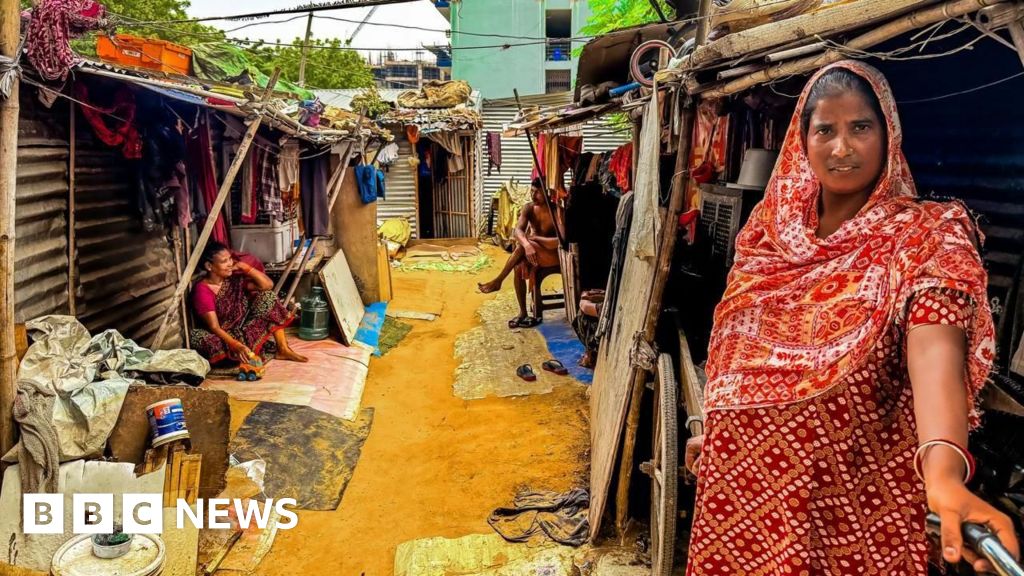
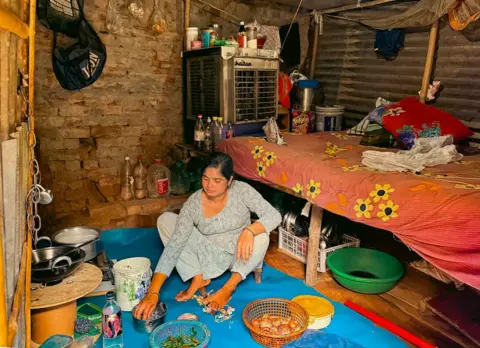
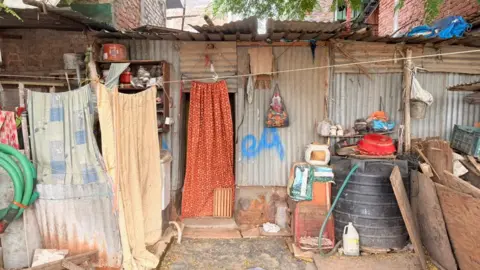
In Gurugram, a high-end suburb just outside Delhi, brilliant SUVs, futuristic skyscrapers and neat apartments contrast strongly with the swarms of mosquitoes, piles of trash cans and tarpaulin barracks.
Inside the closed compounds live some of the richest in India, while in slums near poor migrant workers – mainly domestic aids, garbage pickers and daily wage workers.
Last month, local authorities brought together hundreds of these workers, most of whom said they are Bengalis Muslims in the Indian Western Bengal, in a “verification” to target illegal Bangladai immigrants.
The suspects were held and kept in “detention centers” where they were invited to provide documents to prove their citizenship. Many allege that they were beaten and mistreated by the police during the process. The police deny these allegations.
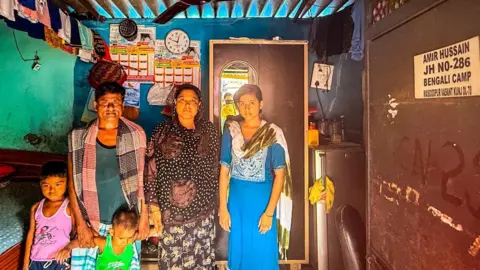
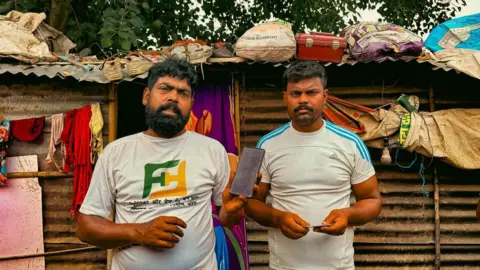
“I had my national identities and identity cards, but they told me that they were false. I spent six days not to know my fate before being finally released,” said Ather Ali Sheikh, a daily wages worker, who has lived in the city for 15 years.
The action has left indelible scars on the social fabric of the city, which prides itself on its cosmopolitan culture. Hundreds of workers fled all night – abandon jobs, houses and, in some cases, even families who are looking forward to escaping.
“I still don’t understand why they suddenly came after me,” said Sheikh. Behind him, his wife has excited their personal effects – torn clothes, old utensils and school books – in fragile boxes.
“Was it because of my language, my religion or because I am poor?”, Mr. Sheikh, his face hardens with anger. “Why were the rich Bengalis residents not held?”
 Zoya Mateen / BBC
Gurugram police deny targeting a particular community. “Neither religion nor the class have nothing to do with the campaign,” Sandeep Kumar, head of public relations, said at the BBC.
He added that of the 250 people collected, only 10 were identified as illegal migrants and will in fact be expelled.
“Everyone was released. No one was mistreated in the centers. We were completely fair and objective.”
Meanwhile, an apprehension is also felt on the other side of the city.
Without workers, lots of waste overflowed with public bins and discharge sites in the streets, which was the residents.
“Our help at home and her husband, who worked as a driver, left and now we have no help,” said Tabassum Bano, who lives in one of the complexes.
Repression against alleged illegal immigrants of the Muslim majority of Bangladesh are not new in India. The countries are divided by a porous border of 4,096 km (2,545 miles) long and have seen movement waves on both sides.
But these efforts seem to have intensified within the framework of the government of Prime Minister Narendra Modi.
In recent months, hundreds of people, including an Indian army Muslim veteran, have been arrested for suspicion of illegal migrants.
 Zoya Mateen / BBC
In the state of northeast of Assam, where the problem has been a powerful lightning point for decades, the authorities “repel” hundreds of Bengali-Muslims in Bangladesh, suspected that they are “illegal bangladeshs”.
Deportations are also underway in Delhi, where some 700 people have been picked up and transported by plane in the United States in the past six months.
This had a scary impact on the community.
In Gurugram, a feeling of shock prevailed over their dust colonies.
“For years, we have cleaned and collected their garbage. Now we are treated like that ourselves,” said Rauna Bibi.
Domestic help, Rauna’s husband came back from Western Bengal on the same day as detentions began. When he heard about it, he was so terrified that he left again – this time, without informing his wife.
“For three days, I wondered if he had been picked up; if he was even alive,” said Rauna. “When we finally talked, he said he hadn’t called because he didn’t want any problems.”
But it is not the behavior of her husband who disturbed Rauna, nor the fact that he was now unemployed. It is the flight of her pride – and the comfort of belonging to a place – which injured her the most, making her feel absurdly insignificant.
“Unlike poverty, I can’t fight with my hard work,” she said. “If they choose us, I would not know how to survive. This slum, the work we do and the houses we clean – that’s our life.”
 Zoya Mateen / BBC
Mr. Kumar says that recent action is based on an opinion from the May Ministry of the Interior which establishes new directives to expel illegal immigrants.
Under the ordinance, all states are required to set up a special working group as well as detention centers to “detect, identify and expel / refer illegal immigrants installed from Bangladesh and Myanmar”.
Each person would receive 30 days to prove their citizenship, during which the authorities refer their documents to their original districts for verification.
If they do not confirm the details, the suspects would be taken by the police “under an appropriate escort, in a group as much as possible”, and given to the border forces for expulsion.
Critics, however, questioned the order, claiming that it does not specify the base on which a person is made suspect.
“At first glance, it is nothing other than the fact that you are talking about Bengali, that you have a Muslim name and that you live in a slum,” said Aakash Bhattacharya, of the National Council of the Central Council of India of the Unions who defends the rights of workers.
What is worse is that none of the suspects receives certificates confirming that their citizenship had already been verified, he added.
“This means that they can be given to the same process, which makes them extremely vulnerable.”
 Zoya Mateen / BBC
 Zoya Mateen / BBC
Mr. Kumar says that Gurugram detention were made on the basis of solid preliminary evidence.
“We checked their phones and found suspicious contacts from Bangladesh. Some of them did not answer questions about their ancestry during the interrogation,” he said.
Suhas Chakma, a human rights worker, says that politics is not necessarily specific to the nun.
“The arrest of Muslims seems to be more because they constitute around 95% of the population of Bangladesh,” he said.
But for a country that has experienced an influx of refugees for decades, India needs a larger refugee law to resolve many of these complex questions, he added.
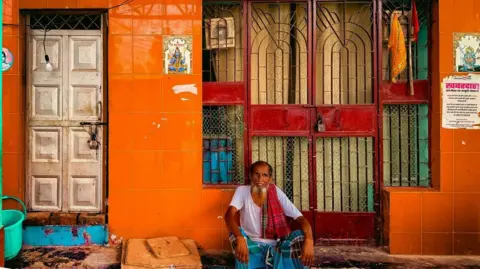
For the moment, Bengali Muslims live with a deep feeling of feeling.
Many of them slept with documents hidden under the pillow in case the misfortune of the strikes.
 Zoya Mateen / BBC
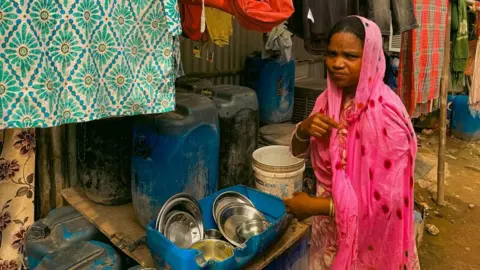
“We are already fighting the harsh reality of our lives. Now we must also fight this,” said Rabi-Ul-Hassan, a resident of Jai Hind Camp, a massive slum located in one of the most chic in Delhi.
Three weeks ago, the authorities cut electricity in the region, instantly plunging some 400 people into the dark.
The action took place after a court judged that the inhabitants of the slums, who say that they have lived there for generations, bellcounted on private land.
“They did it even when the region is recognized as a legal slum by the city’s own urban organization,” said Abhik Chimni, a lawyer who disputes order.
Since then, the residents have been in a sort of stupor, dazed, angry and tired. “The heat is unbearable. The food continues to rot and the children keep crying. At night, we try to sleep outside, but mosquitoes bite us,” said Baijan Bibi.
“I am so exhausted,” she continued, “that sometimes I wonder if it is better to live in a detention center. At least there will be a fan there, right?”
https://ichef.bbci.co.uk/news/1024/branded_news/b4a7/live/c0469e60-738a-11f0-8071-1788c7e8ae0e.jpg
About The Author